administrador

administrador

Monday, 16 November 2020 11:11

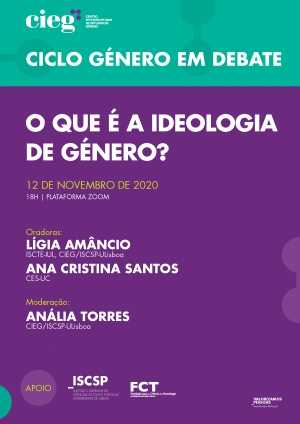
19 | What is gender ideology?

Gender in Debate session, 12 November 2020. The event featured invited speakers Lígia Amâncio (ISCTE-IUL, CIEG/ISCSP-ULisbon) and Ana Cristina Santos (CES-UC). The moderator of the debate was CIEG’s Coordinator, Anália Torres.

The video of the session is available here.
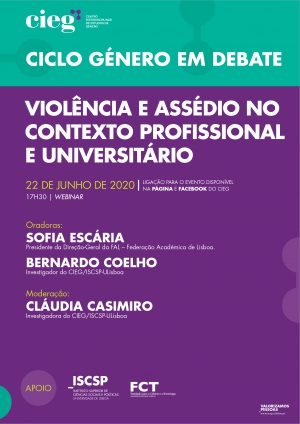
Gender in Debate session, 12 June 2020. The event featured invited speakers Sofia Escária (President of the Board of the Lisbon Academic Federation) and Bernardo Coelho (CIEG’s Researcher). The moderator of the debate was CIEG’s Researcher, Cláudia Casimiro.

The video of the session is available here.
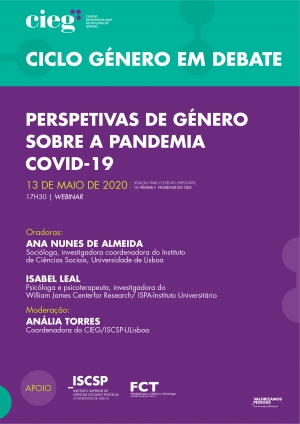
Gender in Debate session, 13 May 2020. This online session reached more than 90 participants. The event featured invited speakers Ana Nunes de Almeida (Sociologist and Research Professor of the Institute of Social Sciences, University of Lisbon) and Isabel Leal (Psychologist and psychotherapist, researcher at William James Center for Research/ISPA-Instituto Universitário). The moderator of the debate was CIEG’s coordinator, Anália Torres.

The video of the session is available here.
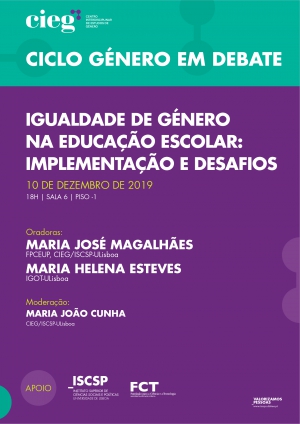
 

Gender in Debate session, 10 December 2019. The session featured invited speakers Maria José Magalhães (FPCEUP/CIEG) and Maria Helena Esteves (IGOT-ULisbon), with moderation of Maria João Cunha (CIEG).
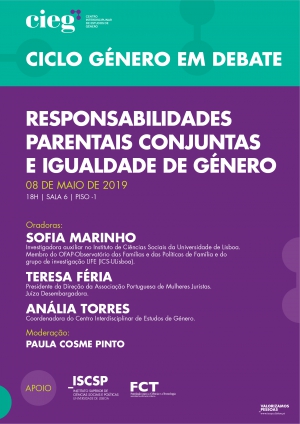
Gender in Debate session, 8 May 2019. The session featured invited speakers Sofia Marinho, Researcher at ICS-ULisbon, member of the OFAP and of the research group LIFE; Teresa Féria, President of the Portuguese Association of Jurist Women and Judge of the High Court; and Anália Torres, CIEG’s Coordinator. The moderator of the debate was the Journalist Paula Cosme Pinto.
Monday, 09 April 2018 11:05

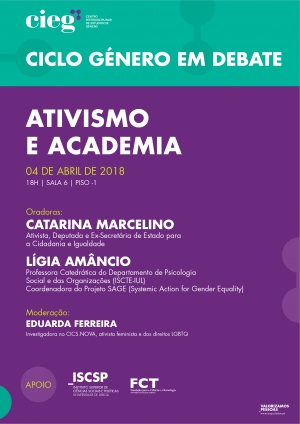
14 | Activism and Academia

Gender in Debate session, 4 April 2018. The session featured invited speakers Catarina Marcelino (former Secretary of State for Citizenship and Equality, deputy and activist) and Lígia Amâncio (Full Professor of Social and Organizational Psychology at ISCTE-IUL and SAGE – Systemic Action for Gender Equality Project Coordinator). The moderator of the debate was Eduarda Ferreira (researcher at CICS.NOVA, feminist and LGBT rights activist).
CIEG's Researcher, Joana Bessa Topa, participates in the transdisciplinary network “Women on the Move”, funded within the European Cooperation in Science and Technology (COST).
 
The main goal is to show the presence and economic contribution of female migrants in European history. 
 
More information can be find here.

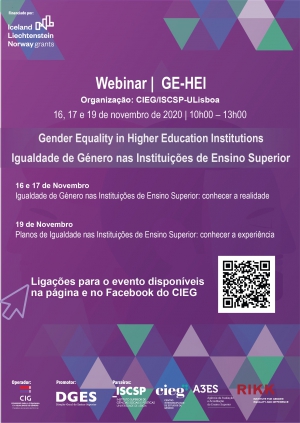
Webinar GE-HEI – Gender Equality in Higher Education Institutions, hosted by CIEG/ISCSP-ULisbon, took place on 16, 17 and 19 November 2020.

The Opening Session featured João Sobrinho Teixeira (Secretary of State of Science, Technology and Higher Education), Ricardo Ramos Pinto (President of ISCSP-ULisbon), Ângela Noiva (DGES) and Anália Torres (Coordinator of the Project and CIEG’s Coordinator).

Two keynote speakers participated in the Webinar, Thomas Smidt (RIKK), who presented contributions from the Icelandic project partner, and Rosemary Deem (Royal Holloway, Univ. of London), scientific consultant of the Project, who presented on the United Kingdom experience.
 
The following sessions presented preliminary results of the ongoing research. The two sessions on 16 November featured Maria de Lourdes Machado-Taylor and Pedro Matias (from A3ES), and CIEG’s team, represented by Rui Brites (GE-HEI, ISCTE-IUL) and Bernardo Coelho (GE-HEI, CIEG/ISCSP-ULisbon). The session on 17 November featured Anália Torres (GE-HEI, CIEG/ISCSP-ULisbon), Paula Campos Pinto (GE-HEI, CIEG/ISCSP-ULisbon), Diana Maciel (GE-HEI, CIEG/ISCSP-ULisbon) and Ellen Theodoro (research assistant in the project).
 
On the last day, the Opening Session featured Sandra Ribeiro (President of CIG) and was followed by two roundtables with the presence of Coordinators of ongoing and finished Equality Plans in Higher Education Institutions in Portugal, namely: Amélia Augusto (UBI), Lígia Amâncio (ISCTE-IUL), Elsa Fontainha (ISEG-ULisboa), Mónica Lopes (UC), Elvira Fortunado (NOVA), Maria Lucinda Fonseca (IGOT-ULisboa) and Teresa Carvalho (UA). The Closing Session featured Rosa Monteiro (Secretary of State for Equality and Citizenship), Ângela Noiva (DGES) and Anália Torres (Coordinator of the Project and CIEG’s Coordinator).
 
The Project Ge-HEI, funded by the EEA Grants 2014-2021, is promoted by the Directorate General for Higher Education (DGES). The project’s operating organisation is the Commission for Citizenship and Gender Equality (CIG) and the study is being developed by the Interdisciplinary Centre for Gender Studies (CIEG), in partnership with RIKK – Institute for Gender, Equality and Difference at the University of Iceland and A3ES – Agency for Assessment and Accreditation of Higher Education.
 
The videos and presentations are available in the project website.
 

allinteract

CIEG is partner in the research project “ALLINTERACT: Widening and Diversifying Citizen Engagement in Science”, awarded with a H2020 grant. The general goal of the project is twofold: on the one hand, to create new knowledge about how to transform potential citizen participation in science into actual engagement in scientific research. On the other hand, to unveil new ways to engage societal actors, including young citizens and groups that have traditionally been excluded from science.


The consortium is coordinated by the University of Barcelona (Spain) in partnership with the University of Helsinki (Finland), Rijksuniversiteit Groningen (Netherlands), Universita’Degli Studi di Milano-Bicocca (Italy), Institute of Political and Social Sciences of the University of Lisbon (Portugal), the Chancellor, masters and scholars of the University of Oxford (United Kingdom) and the European Parents Association (Belgium).

FACEBOOK: https://www.facebook.com/allinteract/ (@allinteract)

TWITTER: https://twitter.com/allinteract (@allinteract)

INSTAGRAM: https://www.instagram.com/allinteract/?hl=en (@allinteract)

2017 FCT H cor

Violence against women tended to increase during the COVID-19 pandemic, according to international reports and scientific articles, but we do not yet have data to demonstrate it. The Committee's statement on the Istanbul Convention is a benchmark for analyzing the measures of the local Public Administration and the actions of the organized entities to prevent gender and / or domestic violence, identifying innovative and transferable tools developed in this period in Portugal.