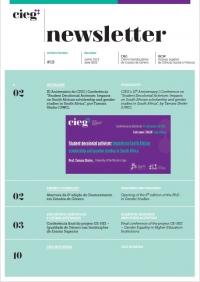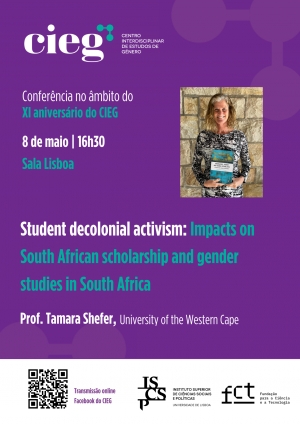
CIEG’s 11th Anniversary Conference, dedicated to the theme "Student decolonial activism: Impacts on South African scholarship and gender studies in South Africa", on May 8, 2023, at ISCSP-ULisboa. The conference was attended by Professor Tamara Shefer, from University of Western Cape and was broadcast live on CIEG's Facebook page.
The event allowed academic discussion on decolonial student activism and its impact on gender studies in South Africa, with the participation of several researchers.
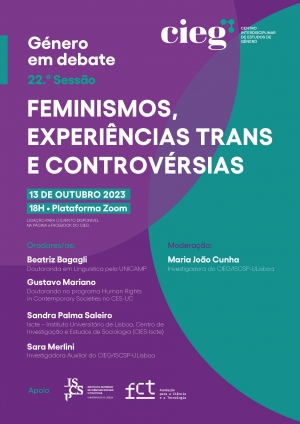
Gender in Debate session, 13 October 2023. The event featured Beatriz Bagagli (PhD candidate at Unicamp), Gustavo Mariano (PhD candidate at CES-UC), Sandra Saleiro (CIES/ISCTE-IUL) and Sara Merlini (CIEG). The moderator of the debate was CIEG's Researcher Maria João Cunha.
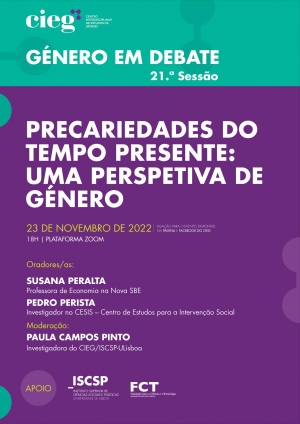
Gender in Debate session, 23 November 2022. The event featured invited speakers Susana Peralta (NOVA SBE) and Pedro Perista (CESIS). The moderator of the debate was CIEG's Researcher Paula Campos Pinto.
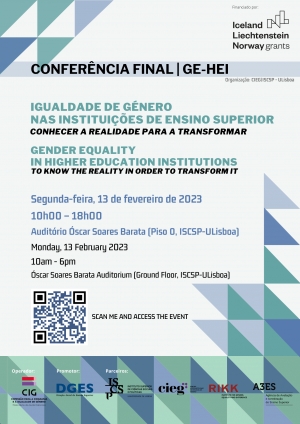
It took place on 13 February, 2023, the final conference of the GE-HEI Project - Gender Equality in Higher Education Institutions, entitled "Gender Equality in Higher Education Institutions: Knowing the reality in order to transform it". The main aim of this conference was to disseminate the results of the project and create a space for sharing knowledge and reflecting on good practices in promoting Gender Equality in Higher Education.
Access the full program here.
The GE-HEI project is promoted by the Directorate General for Higher Education (DGES) and funded by the EEA Grants Financial Mechanism, whose operating entity in Portugal is the Commission for Citizenship and Gender Equality (CIG). The scientific coordination is the responsibility of the Interdisciplinary Center for Gender Studies (CIEG/ISCSP-ULisboa), and its partners are the Agency for Assessment and Accreditation of Higher Education (A3ES) and the Institute for Gender, Equality and Difference at the University of Iceland (RIKK).
Funded by the European Comission and co-funded by the Rights, Equality and Citizenship Programme of the European Comission, the FEM_UnitED partnership, coordinated by the Mediterranean Institute of Gender Studies (Cyprus), gathered entities from five EU countries: Malta, Cyprus, Germany, Portugal and Spain. The project aimed for improve systems-wide responses to IPV/DV by creating an evidence base for raised public awareness and the fostering of multi-disciplinary cooperation and capacity building, adopting a gender-specific victim-centred approach. In other words, FEM_UnitED is about creating evidence for collaborative policy change to prevent femicide. The FEM_UnitED team comprises of advisory board members and country focal points of the European Observatory of Femicide (EOF), having CIEG's research Maria José Magalhães as a member of the research team.
Funded by the CERV program of the European Commission, the project aims to provide an evidence-based analysis of how different types of victim support services can collaborate in responding to the needs of victims of gender-based violence. Promoted by the Victim Support Europe. Team member: Ana Forte.
Funded by CAPP/ISCSP-ULisboa, the project aims to understand the communication of health public policies in Portugal through a mixed method, including content analysis and rhetorical anlysis to the message of governmental communication of heath public policies, content and discourse analysis to news about these subjects, and quantative, semi-structured and in-depth interview to the actors involved. Research tem: Maria João Cunha and Carla Cruz.
Co-Funded by the CERV program of the European Commission, the project focuses on women and children with mental disabilities who are victims of violence in facilities and programmes desgined to serve them. Research team: Patrícia Neca.
Funded by FCT, Care (4) Housing is coordinated by Joana Pestana Lages (DINAMIA'CET/ISCTE-IUL and CIEG/ISCSP-ULisboa). In a close dialogue between theory and practice / research and action, the research aims to explore new housing concepts oriented to 'othered' groups and provide to architects, policy makers, specialists, and other concerned with housing inequalities, a tool for mapping, a full set on design applications, and in situ prototypes, the 'Atlas of Spacial Care'.
News/ Events
CIEG's activities