Versão portuguesa disponível aqui.
Gender, Feminist and Women's Studies: Knowledge, Public Policies and Social Justice
Gender, feminist and women’s studies are currently faced with new challenges and the deepening of old obstacles that compromise their future or may even block it in some countries. The latest financial crisis was followed by a pandemic on a scale only encountered over a century earlier. When this disruption of ways of life and family dynamics was thought to be over, the outbreak of war in Europe accentuated economic struggles, trivialised violence, provoked waves of forced emigration, and accentuated conflict in international relations. This sequence of events was accompanied by the emergence of authoritarian leaderships, by a backlash against science and defence of unfounded knowledge, gathering support from many people, and by a growing influence of religious and political movements, such as populism, seeking to subvert the rule of law and democratic regimes.
Debate and controversy in the public sphere have grown increasingly polarised, often evolving into open conflict and intense antagonism. In this scenario, old challenges such as anti-feminism and attacks on gender studies and gender equality have led to significant setbacks in rights and the attempt to exclude gender studies from academia in some countries. The recent U.S. Supreme Court ruling on abortion sets an extreme example of the retreat of a right recognized for 50 years.
Still, these attacks on gender equality and LGBTQIA+ rights, clear manifestations of sexism, homophobia, racism, classism, and sexual violence, have met strong resistance and opposition from movements mobilising thousands and thousands of people on the streets, media and social media, in truly global events. This contestation, despite involving various sectors of the population, was often mobilised by young people, as in the recent and courageous case of young Iranian women.
It must also be acknowledged that there have been important rights achievements in many countries in recent years, such as the recognition of the right to abortion in Argentina, or of the right to same-sex marriage or gender self-determination, in many countries.
Despite these contrasting dynamics, the advances of authoritarian and far-right forces are particularly concerning, recently rising to power in some European countries, or even though they lost it in others, like the US and Brazil, persisting in underground mobilisations that erode democratic values, preach violence, and call into question basic human rights.
These changes to the quality of democracies, and the struggle for rights and for the improvement of people's living conditions, make gender, feminist and women’s studies increasingly relevant, especially in their intersection with social inequalities, racism, and colonialism, even in a context of polarised debate
The Interdisciplinary Centre for Gender Studies thus invites researchers from national and international institutions to contribute to enhancing knowledge on gender equality issues in different countries, but also on current challenges and future prospects for gender, feminist and women’s studies, through the presentation and debate of research on the following topics:
Gender, feminisms and women’s studies
Policies, institutions and citizenship
Gender and living conditions
Gender and sexualities
Information for submission:
Proposals must contain a maximum of 300 words. Each person may submit a maximum of 2 abstracts as main author.
Congress's accepted Languages: Portuguese, English and Spanish
Important dates:
Registration fees
|
Registration fee |
Early bird (up until December 11th 2023) |
After December 11th 2023 |
|
Participant |
250 € |
300 € |
|
Student |
90 € |
140 € |
|
Lower income e middle-lower income countries |
170 € |
220 € |
| 1 day fee | 100 € | 100 € |
CIEG's III International Congress
January 31st - February 2nd, 2024
Gender, Feminist and Women's Studies: Knowledge, Public Policies and Social Justice
Gender, feminist and women’s studies are currently faced with new challenges and the deepening of old obstacles that compromise their future or may even block it in some countries. The latest financial crisis was followed by a pandemic on a scale only encountered over a century earlier. When this disruption of ways of life and family dynamics was thought to be over, the outbreak of war in Europe accentuated economic struggles, trivialised violence, provoked waves of forced emigration, and accentuated conflict in international relations. This sequence of events was accompanied by the emergence of authoritarian leaderships, by a backlash against science and defence of unfounded knowledge, gathering support from many people, and by a growing influence of religious and political movements, such as populism, seeking to subvert the rule of law and democratic regimes.
Debate and controversy in the public sphere have grown increasingly polarised, often evolving into open conflict and intense antagonism. In this scenario, old challenges such as anti-feminism and attacks on gender studies and gender equality have led to significant setbacks in rights and the attempt to exclude gender studies from academia in some countries. The recent U.S. Supreme Court ruling on abortion sets an extreme example of the retreat of a right recognized for 50 years.
Still, these attacks on gender equality and LGBTQIA+ rights, clear manifestations of sexism, homophobia, racism, classism, and sexual violence, have met strong resistance and opposition from movements mobilising thousands and thousands of people on the streets, media and social media, in truly global events. This contestation, despite involving various sectors of the population, was often mobilised by young people, as in the recent and courageous case of young Iranian women.
It must also be acknowledged that there have been important rights achievements in many countries in recent years, such as the recognition of the right to abortion in Argentina, or of the right to same-sex marriage or gender self-determination, in many countries.
Despite these contrasting dynamics, the advances of authoritarian and far-right forces are particularly concerning, recently rising to power in some European countries, or even though they lost it in others, like the US and Brazil, persisting in underground mobilisations that erode democratic values, preach violence, and call into question basic human rights.
These changes to the quality of democracies, and the struggle for rights and for the improvement of people's living conditions, make gender, feminist and women’s studies increasingly relevant, especially in their intersection with social inequalities, racism, and colonialism, even in a context of polarised debate
The Interdisciplinary Centre for Gender Studies thus invites researchers from national and international institutions to contribute to enhancing knowledge on gender equality issues in different countries, but also on current challenges and future prospects for gender, feminist and women’s studies, through the presentation and debate of research on the following topics:
Gender, feminisms and women’s studies
Policies, institutions and citizenship
Gender and living conditions
Gender and sexualities
Important dates:
Registration fees
|
Registration fee |
Early bird (up until December 11th 2023) |
After December 11th 2023 |
|
Participant |
250 € |
300 € |
|
Student |
90 € |
140 € |
|
Lower income e middle-lower income countries |
170 € |
220 € |
| 1 day fee | 100 € | 100 € |
Venue:
Institute for Social and Political Sciences of the University of Lisbon
Rua Almerindo Lessa, 1300-663 Lisboa (Portugal)
Additional queries:
This email address is being protected from spambots. You need JavaScript enabled to view it.
III International CIEG Congress
January 31st - February 2nd, 2024
Gender, Feminist and Women's Studies: Knowledge, Public Policies and Social Justice
Gender, feminist and women’s studies are currently faced with new challenges and the deepening of old obstacles that compromise their future or may even block it in some countries. The latest financial crisis was followed by a pandemic on a scale only encountered over a century earlier. When this disruption of ways of life and family dynamics was thought to be over, the outbreak of war in Europe accentuated economic struggles, trivialised violence, provoked waves of forced emigration, and accentuated conflict in international relations. This sequence of events was accompanied by the emergence of authoritarian leaderships, by a backlash against science and defence of unfounded knowledge, gathering support from many people, and by a growing influence of religious and political movements, such as populism, seeking to subvert the rule of law and democratic regimes.
Debate and controversy in the public sphere have grown increasingly polarised, often evolving into open conflict and intense antagonism. In this scenario, old challenges such as anti-feminism and attacks on gender studies and gender equality have led to significant setbacks in rights and the attempt to exclude gender studies from academia in some countries. The recent U.S. Supreme Court ruling on abortion sets an extreme example of the retreat of a right recognized for 50 years.
Still, these attacks on gender equality and LGBTQIA+ rights, clear manifestations of sexism, homophobia, racism, classism, and sexual violence, have met strong resistance and opposition from movements mobilising thousands and thousands of people on the streets, media and social media, in truly global events. This contestation, despite involving various sectors of the population, was often mobilised by young people, as in the recent and courageous case of young Iranian women.
It must also be acknowledged that there have been important rights achievements in many countries in recent years, such as the recognition of the right to abortion in Argentina, or of the right to same-sex marriage or gender self-determination, in many countries.
Despite these contrasting dynamics, the advances of authoritarian and far-right forces are particularly concerning, recently rising to power in some European countries, or even though they lost it in others, like the US and Brazil, persisting in underground mobilisations that erode democratic values, preach violence, and call into question basic human rights.
These changes to the quality of democracies, and the struggle for rights and for the improvement of people's living conditions, make gender, feminist and women’s studies increasingly relevant, especially in their intersection with social inequalities, racism, and colonialism, even in a context of polarised debate
The Interdisciplinary Centre for Gender Studies thus invites researchers from national and international institutions to contribute to enhancing knowledge on gender equality issues in different countries, but also on current challenges and future prospects for gender, feminist and women’s studies, through the presentation and debate of research on the following topics:
Gender, feminisms and women’s studies
Policies, institutions and citizenship
Gender and living conditions
Gender and sexualities
Information for submission:
Proposals must contain a maximum of 300 words. Each person may submit a maximum of 2 abstracts as main author.
Congress's accepted Languages: Portuguese, English and Spanish
Important dates:
Registration fees
|
Registration fee |
Early bird (up until December 11th 2023) |
After December 11th 2023 |
|
Participant |
250 € |
300 € |
|
Student |
90 € |
140 € |
|
Lower income e middle-lower income countries |
170 € |
220 € |
| 1 day fee | 100 € | 100 € |
Venue:
Institute for Social and Political Sciences of the University of Lisbon
Rua Almerindo Lessa, 1300-663 Lisboa (Portugal)
Additional queries:
This email address is being protected from spambots. You need JavaScript enabled to view it.
The project Free Choices - Estereótipos não fazem o meu género: escolhas vocacionais e profissionais livres de preconceitos is promoted by UMAR – União de Mulheres Alternativa e Resposta and funded by the Work-life Balance and Gender Equality Programme of the European Economic Area Financial Mechanism – EEAGrants 2014-2021. CIEG/ISCSP-ULisboa, ATEC – Associação de Formação para a Indústria, Associação Nós – Instituição Particular de Solidariedade Social, the University of Jyväskylä (Finland), and the Icelandic Women´s Rights Association (Iceland) are the project’s partners along with various high schools and schools.
The main project’s goals are the deconstruction of gender stereotypes which legitimise and contribute for the reproduction of a sexual segregation of academic and professional choices of youth, fomenting youth’s participation and critical analysis on the prevention of gender stereotypes and the promotion of gender equality. It also aims to develop collaborative work, involving the different agents who have an important role in the transformation of this paradigm of segregation. And to implement a prevention of stereotypes and promotion of equality programme, in the school context, aimed at vocational orientation, with students from the 7th to the 9th grades.
Manuela Tavares (CIEG/ISCSP-ULisboa | UMAR) is the project’s coordinator and Maria João Cunha (CIEG/ISCSP-ULisboa) the scientific consultant.
You can follow all the project’s activities through the projects Instagram, TikTok and website.
FCT announced the opening of the 6th edition of the Individual Call to Scientific Employment Stimulus. Applications can be submitted from April 4th until May 3rd 2023.
CIEG will be accepting applications as the host institution from researchers with PhD whose projects are aligned with CIEG's goals and research lines. More information on the Centre's research lines, here.
Interested candidates must submit the request to have CIEG as hosting institution by April 17th 2023 with the documents and information below:
All contact made regarding the application must be made through this e-mail This email address is being protected from spambots. You need JavaScript enabled to view it., with subject “CEEC 6ª edição – Manifestação de Interesse”.
Additional information on the Notice of the Call, the Regulation, and also on FCT's website.
IMPORTANT: The application to CIEG as the hosting institution does not substitute the application to FCT, here.
The Interdisciplinary Centre for Gender Studies of the Institute of Social and Political Sciences (CIEG/ISCSP-ULisboa) opens a call for granting 1 (one) PhD Research Studentship, in the area of Gender Studies, under the FCT Regulation for Studentships and Fellowships (RBI) and the Research Fellowship Holder Statute (EBI).
The grant will be funded by the Foundation for Science and Technology (FCT) under the terms of the Collaboration Protocol for Funding of the Pluriannual Research Grant Plan for PhD Students, signed between the FCT and the R&D Unit CIEG, Nº 4304.
The call is open between March 27th 2023 and the 17.00h April 17th 2023.
The portuguese version is available here.
The english version is available here
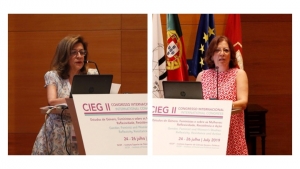
Opening Session
Anália Torres (CIEG's Coordinator) and Alice Trindade (Vice-President of ISCSP-ULisboa)
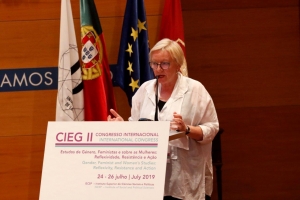
Conceptualising Gender: History, Politics and Practice - Sue Scott, President of ESA, CWS/Univ. de York
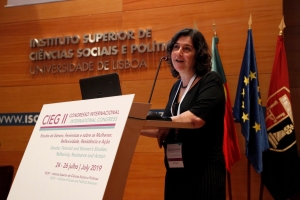
The theorical-political legacy of Gender Studies and feminist agendas in contemporary Brazil - Karla Bessa, PAGU/UNICAMP's Coordinator
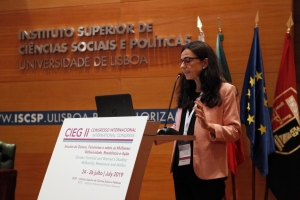
Revisiting consent, communicative acts and gender violence - Marta Soler, CREA-UB's Director
News/ Events
CIEG's activities